The Menopause Mind-Body Connection: Why Your Changing Body Is Preparing You for Your Best Years
Discover how menopause is more than a hormonal shift - it’s a powerful mind-body transformation that prepares women for their most vibrant years. Learn about the science behind brain and body changes, how to support emotional balance, and why this stage of life can bring renewed clarity, strength, and purpose. Empower your midlife wellness journey with holistic insights for women over 50.
THRIVING AFTER 50
The Menopause Mind-Body Connection: Why Your Changing Body Is Preparing You for Your Best Years
According to the 2022 KFF Women's Health Survey, only 35% of women ages 40-64 report that their healthcare provider talked to them about what to expect during menopause, yet this transition affects 100% of women. If you're feeling unprepared or overwhelmed, you're not alone. My experience with doctors regarding menopausal questions and issues was also never properly addressed. It was only recently that I discovered a doctor who has an integrated health approach that I finally felt some of my concerns were finally attended to. After a series of medical tests, I was assured that nothing was wrong and some changes are normal. I strongly urge women to listen to their bodies and do research as widely as possible to find what path to take concerning their menopause journey.
The first time I placed the milk carton in the cabinet with the mugs instead of the fridge, I thought it was hilarious. The second time it happened, was when I realized my body was changing. Brain fog… (Click here for more on brain fog)I later understood was what experts call it!
For me...misplacing items became more frequent. I would also suddenly find it difficult to express myself…occasionally struggling to find the correct words. Oh, and the forgetfulness is the worst for me. Perhaps you have also experienced something similar, or maybe you wake up drenched in sweat at night, your heart racing for no apparent reason. At 50, I thought I was too young for "all that menopause stuff." Eventually, I realized something profound: maybe my body wasn't betraying me. What if it was preparing me for something bigger?
Maybe you've had a similar moment. Perhaps it's not brain fog that makes you forget words mid-sentence; it could be mood swings that seem to come from nowhere, or energy crashes that leave you wondering where your vibrant self went.
What if I tell you that these changes in your body do not mean your changing body is failing you?. Rather, research shows that you are transitioning into a phase of life that can be your most purposeful and powerful season yet.
"I praise you because I am fearfully and wonderfully made; your works are wonderful, I know that full well." - Psalm 139:14
Think about this for a moment: The very hormones that now seem to cause such upheaval - hot flashes, mood swings, sleepless nights - are the same hormones that once made it possible for you to experience one of life's greatest joys: bearing children. God designed women with such intricate complexity, with reverence and respect, setting us apart as uniquely capable of nurturing new life. Our hormonal system isn't a flaw; it's a divine masterpiece that served one beautiful purpose and is now transitioning to serve another.
Yes, the difficulties we experience during hormonal changes can be overwhelming and sometimes feel unbearable. But this same God who designed our bodies to create, sustain, and birth life also designed us to transition through seasons with purpose. We are fearfully and wonderfully made - not just in our childbearing years, but in every season that follows.
"Therefore, we do not lose heart. Though outwardly we are wasting away, yet inwardly we are being renewed day by day." - 2 Corinthians 4:16
Your body is doing exactly what scripture describes: an outward transition that makes room for inward renewal and strength. The same intricate design that once prepared you for motherhood is now preparing you for a different kind of power - wisdom, clarity, and authentic purpose.
What's Really Happening in Your Body? (And Why It's Actually Brilliant)
Let me share something that might completely shift how you think about menopause. For decades, we've been told this transition is about loss: the loss of fertility, youth, hormones. But emerging research reveals something extraordinary: menopause is actually a sophisticated biological upgrade.
Here's the science made simple: Your ovaries aren't "shutting down." They're changing from their reproductive role to become part of a more integrated hormonal system. Your brain is literally rewiring itself, becoming less reactive and more strategic. Your body is redirecting energy from monthly cycles to what researchers call "post-reproductive vitality."
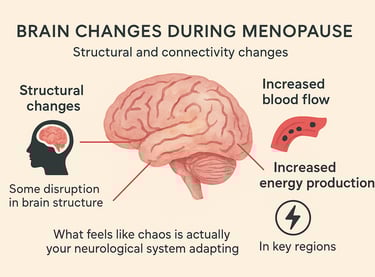
The sketch shows a scientific illustration of the neurological adaptation of a woman’s brain
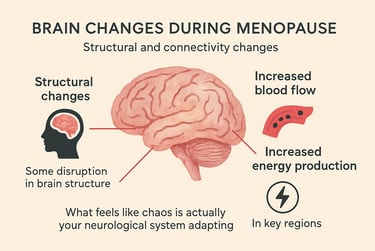
Dr. Lisa Mosconi, a leading neuroscientist studying women's brain health at Weill Cornell Medical College, has published groundbreaking research in Scientific Reports showing that the menopausal brain undergoes significant structural and connectivity changes. Her studies reveal that while menopause initially causes some disruption, the brain develops compensatory adaptations, including increased blood flow and energy production in key regions. What feels like chaos is actually your neurological system adapting and potentially preparing for enhanced function.
Pause and Reflect: Those moments when you feel "not yourself"? You're becoming a more integrated version of yourself.
Understanding the 3 Medical Stages of Menopause
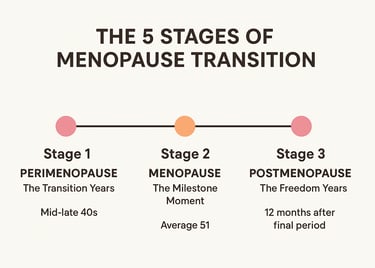
Understanding where you are in this transition can help you navigate it with more confidence. The medical community recognizes three main stages of the menopause journey, based on the internationally recognized STRAW+10 staging system (Stages of Reproductive Aging Workshop, updated 2012).
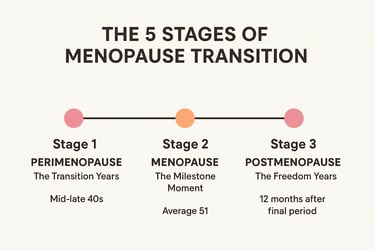
Timeline graphic showing the 3 stages of menopause transition
Stage 1: Perimenopause (The Transition Years)
What It Is: Perimenopause is the transitional phase when your body gradually shifts from reproductive to post-reproductive life. This is when hormonal fluctuations begin and symptoms typically start.
How Long It Lasts: Usually 4-8 years on average, though it can vary from a few months to as long as 10 years.
Typical Age Range: Most commonly begins in the 40s (early to mid-40s), though it can start in the late 30s for some women.
What's Happening:
Early Perimenopause: Periods may still be relatively regular, but you might notice changes in cycle length, flow, or PMS intensity. Subtle symptoms like sleep changes, mood shifts, or energy fluctuations may begin.
Late Perimenopause: Periods become markedly irregular - skipping months, varying in length and heaviness. Hot flashes, night sweats, brain fog, and mood changes often intensify. This is typically the most symptomatic phase.
Common Experiences:
Irregular menstrual cycles (longer, shorter, heavier, lighter, or skipped)
Hot flashes and night sweats
Sleep disruption
Brain fog and memory challenges
Mood swings, anxiety, or irritability
Physical symptoms like joint aches or dry skin
If This Is You: Your hormones are changing and are finding new rhythms. This is when targeted support makes the biggest difference. You're not "going crazy" - our body is working incredibly hard through a major biological transition.
Start Here This Week:
Begin tracking your cycles and symptoms in a simple journal
Schedule a comprehensive health check with a healthcare provider knowledgeable about perimenopause
Create your "emergency comfort kit" (cool cloths, calming tea, supportive playlist) for difficult symptom days
A Word of Caution: Be mindful that these symptoms may also be attributed to other life stresses like work challenges, family issues, or relationship difficulties, not necessarily related only to hormonal changes. I would caution about getting too hung up on or obsessing over these symptoms. Many women in their 40s are building careers, getting married, having children, or traveling - and that's good. The aim of understanding these stages is to know why our bodies change and how we can navigate each season with more ease, not to create anxiety.
Stage 2: Menopause (The Milestone Moment)
What It Is: Menopause is not actually a stage you "go through" - it's a specific point in time. Medically, you've reached menopause when you've gone 12 consecutive months without a menstrual period.
When It Happens: The average age is 51, though it can occur anywhere from the late 40s to mid-50s.
What's Happening: This marks the official end of your reproductive years. Your ovaries have completed their transition from active hormone production to a new, more integrated role in your body's hormonal system.
Common Experiences:
Hot flashes may continue but often begin to stabilize
For many women, symptoms persist for a significant period and may benefit from supplements or Hormonal Replacement Therapy (HRT)
Many women report feeling like they're emerging from a fog
There's often a sense of "finding yourself again," but different than before
If This Is You: Congratulations! You've crossed the bridge. Your body is stabilizing into its new hormonal rhythm. Focus on building your post-menopausal vitality.
Start Here This Week: Celebrate this milestone and begin planning how you want to use your newfound energy and freedom.
Stage 3: Postmenopause (The Freedom Years)
What It Is: Postmenopause encompasses all the years following menopause - essentially, the rest of your life after your final period.
When It Begins: Starting 12 months after your final period and continuing for the rest of your life.
Typical Timeline:
Early Postmenopause (first 2-5 years): Hormones continue stabilizing; some symptoms may persist but typically diminish
Late Postmenopause (5+ years): Hormones reach their new baseline; most women experience significant symptom relief
What's Happening: Your body has completed its hormonal transition. Estrogen and progesterone settle at new, lower baseline levels. Many of the disruptive symptoms of perimenopause subside.
Common Experiences:
Hormones reach their new baseline
Many symptoms subside significantly for a large number of women
Increased confidence, decisiveness, and authenticity
Research shows this stage often brings increased life satisfaction and emotional stability
Stable energy patterns without monthly hormonal fluctuations
Enhanced focus and sustained concentration
If This Is You: Welcome to what many women call their "freedom years." Your body has completed its transition, and you're equipped with hard-won wisdom and biological advantages.
Start Here This Week: Identify one area where you want to use your post-menopausal clarity and confidence to make a positive impact.
The Hidden Gifts Your Body Is Preparing
Society focuses on menopause symptoms, but research reveals remarkable benefits that emerge from this transition:
Neurological Changes
Research shows that during menopause, the brain undergoes significant structural adaptations:
Brain regions develop compensatory mechanisms, including increased blood flow
Enhanced ATP (energy) production in areas experiencing change
Structural reorganization that may support different cognitive strategies
Potential for improved emotional regulation as hormones stabilize
Psychological Liberation
Reduced people-pleasing: Declining estrogen correlates with decreased need for external approval
Increased assertiveness: Many women report feeling more comfortable setting boundaries
Authentic self-expression: The hormonal changes often facilitate more genuine communication
Clarity of priorities: Many women describe a newfound ability to distinguish what truly matters
Physical Health Considerations
Freedom from monthly cycles: No more planning around periods, PMS, or reproductive concerns
Cancer risk complexity: The relationship between menopause timing and cancer risk is nuanced:
Endometrial cancer: Early menopause may reduce the risk of estrogen-sensitive endometrial cancer due to shorter lifetime estrogen exposure. The "unopposed estrogen hypothesis" shows that prolonged exposure to estrogen without progesterone can stimulate endometrial cell proliferation, increasing cancer risk. Later menopause is associated with higher endometrial cancer risk due to longer estrogen exposure. (Sources: Pike MC et al., "Menopausal hormone therapy and risk of endometrial cancer," Maturitas 2013; Xu et al., "Age at Menopause and Risk of Developing Endometrial Cancer: A Meta-Analysis," Hindawi 2019)
Breast cancer: Later menopause may slightly increase breast cancer risk due to longer estrogen exposure. Women who go through menopause after age 55 have higher breast cancer risk than those who experience menopause at 45 or younger. For every year older a woman is at menopause, her breast cancer risk increases by about 3%. (Sources: Komen Foundation, "Breast Cancer Risk: Age at Menopause," 2024; Key TJ et al., "Oestrogen exposure and breast cancer risk," Breast Cancer Research 2003)
Stable energy patterns: Once hormones stabilize, many women report more consistent daily energy
Enhanced focus: Without monthly hormonal fluctuations, sustained concentration often improves
Understanding Your Symptoms: The Science Behind What You're Experiencing
Knowledge is power. When you understand WHY these symptoms are happening, they become less scary and more manageable. Here's what's really going on in your body:
Memory Challenges and Forgetfulness
What's happening: Lower estrogen levels temporarily impact the hippocampus, the brain's memory center. This reduced estrogen also affects neurotransmitter function, causing those frustrating "What was I saying?" moments.
What helps: Mental exercises, omega-3 fatty acids, adequate sleep, and patience. Your brain is adapting, and memory typically improves post-transition.
Mood Swings and Emotional Variability
What's happening: Hormonal fluctuations directly influence your limbic system, which regulates emotions. Estrogen and progesterone shifts can heighten anxiety, irritability, and emotional sensitivity.
What helps: Regular exercise, stress management techniques, talking to supportive people, and recognizing these feelings as temporary hormone-driven responses, not character flaws.
Sleep Disruption and Insomnia
What's happening: Hot flashes and night sweats fragment your sleep cycles, reducing the deep, restorative sleep your brain needs for recovery. Hormonal changes also affect your body's temperature regulation and circadian rhythms.
What helps: Cool sleeping environment, moisture-wicking or breathable sleepwear, consistent sleep schedule, and avoiding caffeine after 2 PM.
Reduced Focus and Concentration
What's happening: The prefrontal cortex (your brain's executive control center) is highly sensitive to hormonal changes. Attention difficulties aren't laziness; they're a direct result of neurological adaptation.
What helps: Single-tasking instead of multitasking, breaking large tasks into smaller steps, taking regular movement breaks, and writing everything down.
Increased Stress Response
What's happening: Cortisol regulation is affected during menopause, amplifying your stress response and sometimes causing mood instability. Your body's stress thermostat is recalibrating.
What helps: Mindfulness practices, deep breathing exercises, reducing unnecessary obligations, and being compassionate with yourself.
Neural Plasticity Changes
What's happening: Your brain is undergoing synaptic remodeling. Hormonal shifts trigger your brain to adapt differently post-menopause, influencing learning and adaptation processes.
What helps: Continued learning, new experiences, social engagement, and trusting that your brain is reorganizing for long-term benefit.
Your Emergency Toolkit for Challenging Days
Now that you understand the "why," here are practical strategies for managing symptoms in the moment:
For Intense Hot Flashes:
Layer clothing so you can adjust quickly
Keep cooling tools handy: small fan, cool cloth, ice pack
Practice cooling breath: inhale for 4, hold for 4, exhale for 8
Remember: Each hot flash typically lasts 30 seconds to, on average, 5 minutes. Sometimes up to 10 minutes. You can handle anything for that long.
For Brain Fog Days:
Write everything down (your brain isn't broken, it's changing)
Do one thing at a time instead of multitasking
Exercise for 10 minutes to increase blood flow to the brain
Be patient with yourself: cognitive clarity often returns as hormones stabilize
For Emotional Intensity:
Name the feeling ("I'm experiencing anxiety" vs. "I am anxious")
Move your body for 5 minutes (walk, stretch, dance)
Connect with supportive people who understand this transition
Remember: Emotional intensity often precedes breakthrough clarity
For Sleep Disruption:
Keep the room cool (ideally 65-68°F)
Prepare for night sweats: breathable sleepwear, a towel by the bed
Create a wind-down routine starting 2 hours before bed
If you wake up: practice gratitude or gentle breathing rather than checking the clock or your cell phone.
Supporting Your Brain Health During Menopause
Beyond managing symptoms, you can actively support your brain's adaptation process. Here are evidence-based strategies that work:
Balanced Nutrition
Why it matters: Antioxidant-rich foods support neural integrity and provide the building blocks your brain needs during this transition.
What to prioritize:
Leafy greens (spinach, kale) for folate and B vitamins
Fatty fish (salmon, sardines) for omega-3s that support brain cell membranes
Berries for antioxidants that protect against oxidative stress
Nuts and seeds for vitamin E and healthy fats
Whole grains for steady energy and B vitamins
Practical tip: Aim for a "rainbow plate" at each meal to maximize diverse nutrients.
Regular Exercise
Why it matters: Physical activity enhances brain blood flow and plasticity, literally growing new neural connections and supporting mood regulation.
What works best:
Aerobic exercise (walking, swimming, cycling) for 30 minutes, 5 days a week
Strength training 2-3 times weekly to support muscle and bone health
Any movement you enjoy enough to do consistently
Practical tip: Start with 10-minute walks and gradually increase. Consistency matters more than intensity.
Mindfulness activities
Why it matters: These practices reduce cortisol (stress hormone) levels and support emotional balance, directly countering menopause-related stress responses.
What to try:
Deep breathing exercises (4-7-8 breathing technique)
Progressive muscle relaxation before bed
Mindful walking in nature
Journaling to process emotions
Practical tip: Start with just 5 minutes daily. Even brief practice creates measurable changes in brain stress response.
Sleep Hygiene
Why it matters: Quality sleep is when your brain consolidates memories, clears metabolic waste, and repairs itself. Prioritizing restful, uninterrupted sleep cycles supports every aspect of brain health.
What helps:
Consistent sleep and wake times (even on weekends)
Cool, dark bedroom (65-68°F ideal)
No screens 1-2 hours before bed
Calming bedtime routine (warm bath, reading, gentle stretching)
Limit caffeine after 2 PM and alcohol close to bedtime
Practical tip: If you can't fall asleep within 20 minutes, get up and do a calming activity until you feel sleepy again. Alternatively, do breathing exercises. Normally, I will just get up and pray, and go back to bed when I become sleepy again.
Here's what the medical community is finally acknowledging about post-menopausal life:
Cognitive Adaptation: Dr. Mosconi's research in The Menopause Brain shows that while the menopausal brain undergoes temporary disruption, it emerges with structural reorganization and improved emotional regulation capacity. Many women report better decision-making abilities and increased creative problem-solving after the transition.
Emotional Stability: Studies indicate that post-menopausal women often experience improved conflict resolution skills, greater emotional resilience, and enhanced ability to prioritize effectively.
Leadership and Confidence: Research from various institutions shows that many women report increased willingness to take calculated risks, comfort with leadership roles, ability to speak up for their beliefs, and confidence in their decision-making.
Physical Health Opportunities: Post-menopausal women who maintain healthy lifestyles often experience improved muscle tone (when supported with proper exercise), better sleep quality (once hormones stabilize), enhanced immune function, and reduced inflammation when supported with proper nutrition.
Research Reality Check: While menopause symptoms are real and can be challenging, the narrative of inevitable decline is outdated. Modern research shows this transition as preparation for potential vitality.
Your Official Permission Slip for This Transition
Our culture treats menopause like a medical condition to be endured, but biology tells us a different story. This is actually a time of physiological liberation.
"For I know the plans I have for you," declares the LORD, "plans to prosper you and not to harm you, plans to give you hope and a future." Jeremiah 29:11
This transition isn't random or cruel. Your body is following a divine design, preparing you for the future God has planned.
You now have permission to:
Honor your body's need for different support during this transition
Speak openly about what you're experiencing without shame
Demand knowledgeable healthcare that supports your transition
Say no to obligations that drain your energy during this important time
Invest in your health and wellness as a priority, not a luxury
Embrace the confidence and clarity that often emerge post-transition
Redefine what vitality looks like for this season of your life
Your Mind-Body Wellness Action Plan
The woman you're becoming through this transition has access to both biological advantages and hard-won wisdom. Here's how to support yourself through the process:
This Week, Do This:
Create your emergency toolkit with comfort items for difficult days
Share this post with one woman who might need to hear this perspective
This Month, Commit To:
Track your patterns (symptoms, triggers, what helps) for deeper self-understanding
Find knowledgeable healthcare support that views menopause as a natural transition
Connect with other women navigating similar experiences
This Season, Focus On:
Building your support network of people who understand this journey
Experimenting with wellness strategies that support your changing body
Preparing for your post-menopausal vitality by investing in what matters most
Long-term, Remember:
Your body isn't failing you. It's completing one of the most sophisticated biological transitions possible, preparing you for what research consistently shows can be your most authentic, confident, and purposeful years.
Over time, the hot flashes will subside, the brain fog will clear, the emotional intensity will stabilize, but the wisdom, confidence, and freedom you're gaining? Those are permanent upgrades and gains
"Even to your old age and gray hairs I am he, I am he who will sustain you. I have made you and I will carry you; I will sustain you and I will rescue you." Isaiah 46:4
This isn't the beginning of a decline. It's preparation for revitalization.
As Ecclesiastes 3:1 reminds us, "There is a time for everything, and a season for every activity under the heavens." You're not ending - you're entering a new season. One that requires different wisdom, different strength, and offers different blessings. Trust the process. Honor the journey. Embrace the woman you're becoming.
What's Your Experience?
And if this post helped shift your perspective even a little, please share it with another woman who might need to hear that her changing body is preparing her for greatness, not decline.
Research Sources & Further Reading
For deeper exploration of the research mentioned in this post:
Menopause Staging:
Harlow SD, Gass M, Hall JE, et al. "Executive Summary of the Stages of Reproductive Aging Workshop + 10: Addressing the Unfinished Agenda of Staging Reproductive Aging." The Journal of Clinical Endocrinology & Metabolism, 2012;97(4):1159-1168. https://pubmed.ncbi.nlm.nih.gov/22344196/] PubMed CentralOxford Academic
Cancer Risk and Estrogen Exposure:
Pike MC, Henderson BE, Krailo MD, Duke A, Roy S. "Breast cancer in young women and use of oral contraceptives: possible modifying effect of formulation and age at use." Maturitas 2013;75(4):309-315.
Xu L, Sun H, Zhang H, et al. "Age at Menopause and Risk of Developing Endometrial Cancer: A Meta-Analysis." Hindawi 2019. https://pmc.ncbi.nlm.nih.
General Menopause Information:
KFF Women's Health Survey 2022 - National data on women's healthcare experiences with menopause
Dr. Lisa Mosconi's Research - Leading neuroscience research on women's brain health and menopause
"The Menopause Brain" by Dr. Lisa Mosconi - Comprehensive guide to brain changes during menopause
Scientific Reports: Menopause Brain Research - Peer-reviewed study on brain structure and connectivity changes
North American Menopause Society - Comprehensive menopause resources and research
The content on Vitality Edit Well combines personal experience with research-based insights and is intended for informational and inspirational purposes only. This is not professional medical advice. Always consult with qualified healthcare providers regarding your individual menopause experience and before making significant changes to your health regimen.






Resources
Empowering women through health and wellness.
Connect
Support
contact@vitalityeditwell.com
© 2025. All rights reserved.