Brain fog breakthrough: Reclaiming your mental clarity during menopause
Struggling with menopause brain fog? You're not alone-many women experience memory issues, word-finding problems, and mental fatigue. Learn the science behind it, why it's NOT dementia, and 7 evidence-based strategies to reclaim your clarity.
PHYSICAL WELLNESS
Brain Fog Breakthrough: Reclaiming Your Mental Clarity During Menopause
The first time I put the milk in the cabinet with the mugs instead of the fridge, I laughed it off. The second time I walked into a room and completely forgot why I was there, I felt a little concerned. But when I was talking to my friends, mid-sentence, and couldn't find the word I needed - a simple word I'd used a thousand times before - that's when the fear crept in.
"Am I losing my mind?"
If you've asked yourself this question, take a deep breath. You're not alone, you're not "going crazy," and you're definitely not losing your mind.
The landmark Study of Women's Health Across the Nation (SWAN), which followed 3,302 women, found that 44% of early perimenopausal women reported forgetfulness compared to 31% of premenopausal women. Recent research confirms that approximately 60% of women experience cognitive difficulties during menopause.
Yet despite how common this is, many healthcare providers don't discuss it, leaving women feeling isolated and afraid.
Here's what I want you to know: Brain fog during menopause is real, it's temporary for most women, and there are evidence-based strategies that can help. But more importantly, this experience doesn't define you or diminish the incredible things you're still accomplishing every single day.
What You're Really Experiencing: The Science Behind Brain Fog
Let me start with validation: This is not in your head - well, technically it is, but you know what I mean! There are real, measurable biological changes happening in your brain during menopause.
Two brain regions are particularly affected by declining estrogen:
The Hippocampus - Your brain's memory center, responsible for forming and retrieving memories The Prefrontal Cortex - Your executive control center, handling attention, decision-making, and working memory
Both regions are rich in estrogen receptors, making them especially vulnerable to hormonal changes during menopause.
The Estrogen Connection
Estrogen is far more than a reproductive hormone - it's a master regulator of brain function. Research published in the Journal of Neuroscience (2006) shows that estrogen:
Supports memory formation in the hippocampus
Enhances neurotransmitter function (serotonin, dopamine, norepinephrine)
Protects brain cells and promotes neural connections
Increases brain energy through mitochondrial ATP production
Maintains cerebral blood flow for oxygen and nutrient delivery
When estrogen levels decline during perimenopause and menopause, these functions are disrupted:
Decreased synaptic density in memory centers
Reduced serotonin and dopamine function (affecting mood and focus)
Lower acetylcholine levels (impairing attention and learning)
Decreased brain energy metabolism
Changes in cerebrovascular reactivity
According to research published in Scientific Reports, 20% of observations during the menopausal transition show significant weaknesses in verbal learning and memory. A 2022 International Menopause Society White Paper found that 11-13% of women show clinically significant cognitive impairment during this time.
The Progesterone Factor
Progesterone also plays a crucial role. Under normal circumstances, progesterone:
Calms the nervous system
Converts to allopregnanolone (with anti-anxiety and antidepressant effects)
Supports quality sleep
When progesterone declines, women often experience increased anxiety, heightened stress response, and difficulty sleeping - all of which compound brain fog.
The Perfect Storm: Other Contributing Factors
It's Not Just Hormones: The Perfect Storm
Here's what many women don't realize about brain fog:
Hormones are the main culprit. But they're not acting alone.
Think of it like this: Declining estrogen is the storm that's disrupting everything. But it's creating OTHER problems that make brain fog even worse.
It's a domino effect. One thing triggers another. And suddenly, you're in a perfect storm of cognitive chaos.
Let me break down the other factors at play.
Factor 1: Sleep Disruption
What's happening:
Your brain NEEDS sleep to function properly. Specifically, it needs deep sleep.
Here's why: During deep sleep, your brain:
Moves memories from temporary storage to permanent storage
Clears out metabolic waste (including proteins linked to Alzheimer's)
Repairs neural connections
Consolidates what you learned during the day
When sleep gets disrupted - even just waking up a few times - this critical process gets interrupted.
The result: Poor memory, difficulty concentrating, mental fog.
Research from Harvard Health confirms that fragmented sleep directly impairs memory consolidation and cognitive performance.
Translation: Bad sleep equals worse brain fog, regardless of hormones.
Factor 2: Hot Flashes & Night Sweats
What's happening:
About 75% of menopausal women experience hot flashes or night sweats. That's 3 out of every 4 women.
Here's the problem: These don't just make you uncomfortable. They wake you up. Multiple times. Every night.
You got sleep. But you didn't get quality sleep. Your brain never made it through complete sleep cycles.
The result: Your brain didn't get to do its nightly maintenance. Memory consolidation? Interrupted. Mental clarity? Gone.
Studies show that night sweats fragment sleep cycles, reducing the deep, restorative sleep your brain desperately needs.
The vicious cycle:
Hormones cause hot flashes
Hot flashes disrupt sleep
Poor sleep worsens brain fog
Brain fog increases stress
Stress makes hot flashes worse
See the problem?
Factor 3: Elevated Stress (High Cortisol)
What's happening:
Cortisol is your stress hormone. A little bit is normal and helpful.
But chronic stress-the kind many midlife women experience-keeps cortisol elevated all the time.
Why cortisol matters for your brain:
High cortisol directly attacks your hippocampus. Remember, that's your brain's memory center.
Specifically, high cortisol:
Shrinks the hippocampus over time
Impairs memory formation
Makes it harder to retrieve memories
Reduces your ability to concentrate
Increases anxiety (which worsens everything)
Sources of stress during menopause:
The symptoms themselves (worrying about brain fog creates MORE stress), Caring for aging parents,Teenagers or adult children at home, Career demands,Relationship changes, Financial pressures, body image concerns
Research shows that elevated cortisol during menopause significantly impairs hippocampus function, making brain fog worse.
Translation: Stress isn't just "in your head." It's physically changing your brain's ability to function.
Factor 4: Mood Changes
What's happening:
Depression and anxiety are common during menopause. And here's what many women don't realize:
Mood disorders directly impact cognition. Not because you're "too sad to think straight," but because of actual brain chemistry changes.
How depression affects your brain:
Reduces production of brain chemicals needed for memory
Decreases blood flow to certain brain regions
Impairs the hippocampus and prefrontal cortex
Makes it harder to concentrate and process information
How anxiety affects your brain:
Keeps you in "fight or flight" mode constantly
Diverts mental resources to threat detection
Makes it impossible to focus on tasks
Creates racing thoughts that prevent clear thinking
The frustrating part:
You can't tell if the brain fog is from:
Hormones? Depression? Both?
Spoiler: It's usually both. They feed into each other.
Low estrogen can trigger depression. Depression worsens brain fog. Brain fog increases anxiety. Anxiety raises cortisol. High cortisol worsens everything.
Another vicious cycle.
Studies confirm that depression and anxiety during menopause directly impact cognitive function, independent of hormone levels.
Factor 5: Vasomotor Symptoms
What's happening:
"Vasomotor symptoms" is the medical term for hot flashes, night sweats, and blood vessel changes during menopause.
But it's more than just feeling hot.
What's really happening:
Your blood vessels are dilating and constricting irregularly
Blood flow to your brain fluctuates
Your body's temperature regulation is disrupted
Your cardiovascular system is adapting to new hormone levels
Research shows a direct correlation: Women with frequent vasomotor symptoms perform worse on cognitive tests-especially memory tests.
Why this matters:
Your brain needs consistent blood flow. When blood flow fluctuates, so does your cognitive performance.
Translation: Those hot flashes aren't just uncomfortable. They're temporarily reducing your brain's oxygen supply.
Why This is Actually Good News
I know. Reading all this might feel overwhelming.
But here's why understanding the "perfect storm" is actually HOPEFUL:
If multiple factors are contributing to brain fog, then you have multiple ways to improve it.
You don't have to fix everything at once. Improving even ONE factor will help.
For example:
Improve sleep → Brain fog improves, even if hormones aren't fixed yet
Reduce stress → Hippocampus function improves, memory gets better
Treat depression → Cognitive function improves, concentration returns
Manage hot flashes → Sleep improves, which improves everything else
See the pattern?
What This Means for You
Understanding this "perfect storm" helps you:
1. Stop blaming yourself This isn't laziness, aging, or "not trying hard enough." It's biology.
2. Stop fearing dementia Multiple contributing factors actually suggests this ISN'T dementia (which has a single progressive cause).
3. Create a comprehensive plan Target multiple factors, see faster improvement.
4. Have realistic expectations Fixing one thing helps, but addressing multiple factors works best.
5. Give yourself grace You're dealing with a LOT. Be kind to yourself.
Coming Up Next
Now that you understand WHY brain fog happens (hormones + the perfect storm), let's talk about what you can actually DO about it.
The 7 evidence-based strategies coming up will help you address:
Sleep quality, Stress levels, Mood support, Hormone balance, And more
You're not powerless. Not even close.
"My grace is sufficient for you, for my power is made perfect in weakness." - 2 Corinthians 12:9
Even in this perfect storm, you're not alone. God's grace is sufficient. His power works best when you feel weakest.
Learn More About Contributing Factors:
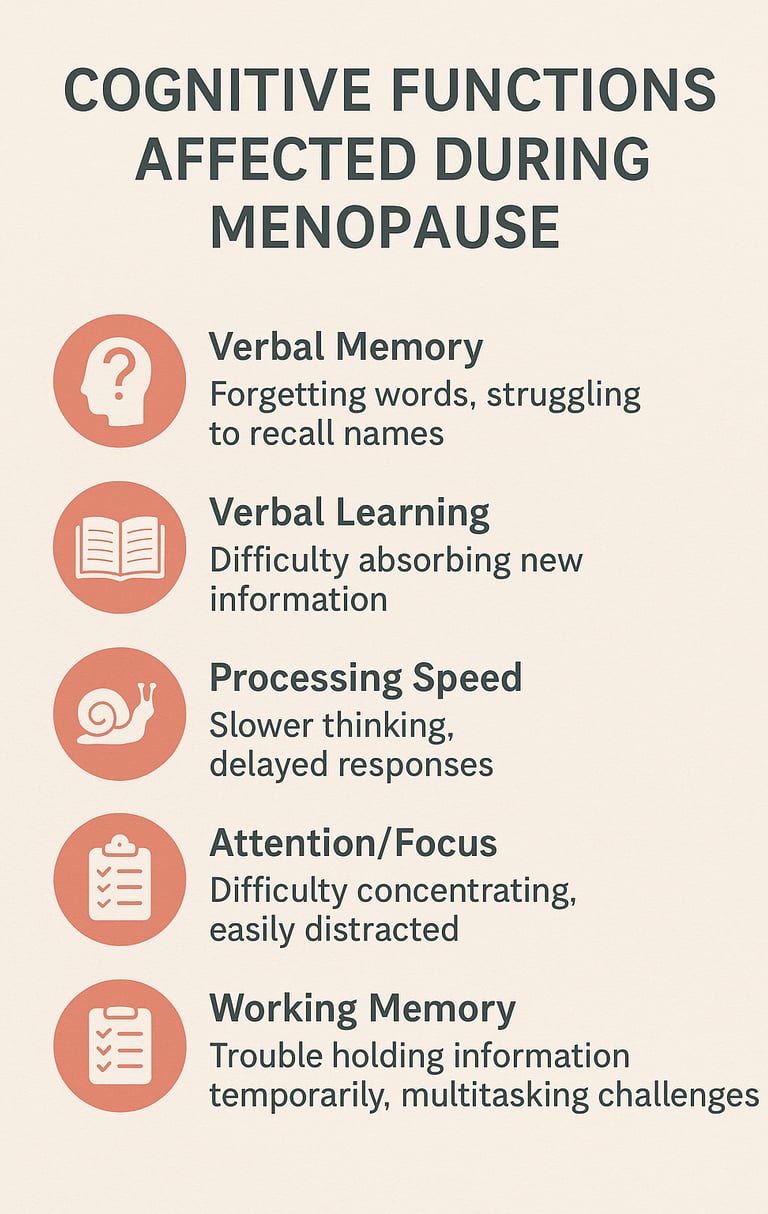
Which Cognitive Functions Are Actually Affected?
Most Common Complaints that women have centre around the following:
Based on extensive research including the SWAN longitudinal study and the International Menopause Society's 2022 White Paper, this is what women most commonly experience
The Reassuring Reality:
Despite these complaints, 87-89% of women maintain cognitive function within the normal range. This means that while you may feel impaired, objective testing often shows your brain is still functioning normally-just differently than before.
Cue-Dependent Memory Retrieval Deficit: When Memories Need a Reminder
What It Is
Cue-Dependent Memory Retrieval Deficit is one of the most unsettling experiences of menopause brain fog. You have a conversation with someone - make plans, share information, discuss details - then hours later when you see them again, you have absolutely zero recollection of the earlier interaction. They mention something specific you said, and suddenly the entire memory floods back in vivid, complete detail.
It's terrifying. You wonder: "Did that even happen? Am I losing my mind? How could I completely forget that?"
My Experience
One morning, I ran into a family member. We greeted each other warmly, chatted briefly, and I took my cellphone from the charger, went back to my room, and proceeded with my morning routine.
An hour or two later, I saw the same family member again. I greeted him cheerfully, as if seeing him for the first time that day.
He looked at me with a puzzled expression - genuinely believing I was right. "We already saw each other this morning," he said gently.
"No, we didn't," I insisted, completely confused.
He simply said, "You took your phone..."
Instantly, like a light switch flipping on, the entire morning interaction flooded back in perfect, vivid detail. The greeting. Our conversation. taking my Phone from the charger, walking to my room. Everything! It had been there the whole time - I just couldn't access it until he gave me that specific cue.
The feeling was chilling. How could I have completely forgotten something that happened just hours earlier? What else was I forgetting? Was this early-onset Alzheimer's? The fear crept in. Again.
The Science (Simply Explained)
What a relief it was when I found an explanation for what happened that day. Here's what I learned so many women experience. It is actually not so bad, but it is crucial to understand: The memory IS stored in your brain (that's why you remember it when given a specific cue!). What's impaired is spontaneous retrieval-your brain's ability to pull up that memory without a specific reminder.
Research published in Climacteric (2022) and Journal of Steroid Biochemistry and Molecular Biology (2014) demonstrates that declining estrogen affects the hippocampus and prefrontal cortex - the regions handling memory encoding and retrieval.
During the encoding phase (when you're experiencing the event), lower estrogen causes your brain to create less distinctive, less elaborated memory traces. Your brain processes events more generically rather than with rich, idiosyncratic detail. This doesn't mean the memory isn't stored - it means it needs a more specific cue to retrieve it.
Scientific evidence confirms that while spontaneous recall becomes harder during menopause, cue-dependent recall still works effectively when given specific reminders. This is a retrieval problem, not a storage problem.
Here Is How You Can Tell The Difference Between Menopause Brain Fog And Dementia
Menopause Brain Fog:
You forget something happened - Someone reminds you ("You took your phone") - BOOM - The entire memory floods back in perfect detail - This pattern repeats during hormonal changes - It gets better after menopause
Dementia:
1. The memory was never stored in the first place
2. Even with reminders, you can't recall it
3. Memory loss gets progressively worse over time
4. It doesn't improve - it continues declining
5. Recent memories fade while old ones remain (at first)
The Proof You DON'T Have Dementia:
You CAN remember when someone gives you a specific cue.
Read that again.
If someone mentions "You took your phone," and suddenly the whole morning comes rushing back-that proves my brain stored the memory successfully. My brain just needed help finding it again.
In dementia, that memory was never stored. No amount of cueing brings it back.
What the Research Shows:
The International Menopause Society studied this extensively. Their 2022 White Paper confirms: menopause brain fog is fundamentally different from dementia.
The science is clear:
Brain fog during menopause is temporary
Cognitive function stabilizes after menopause
Most women return to their baseline
Translation: Most women will NOT develop dementia. What you're experiencing now doesn't necessarily increase your risk.
When to Worry (and See a Doctor):
You should get evaluated if you experience:
Memory loss that interferes with daily tasks
Getting lost in familiar places
Forgetting how to do routine tasks you've done for years
Personality changes or inappropriate behavior
Unable to follow conversations or TV shows
Forgetting the names of close family members
But forgetting why you walked into a room? That's menopause, not dementia.
Forgetting you already greeted someone? That's hormone-related retrieval issues, not Alzheimer's.
Can't find the word for "refrigerator"? That's estrogen affecting your language centers, not brain disease.
The Bottom Line:
If you're worried enough to read this article, research your symptoms, and understand what's happening - your brain is working just fine.
Women with early dementia typically don't recognize they have memory problems. You do. That's actually a good sign.
"For God has not given us a spirit of fear, but of power and of love and of a sound mind." - 2 Timothy 1:7
You have a sound mind. It's adapting to hormonal changes, but it's sound. This season is temporary. God's promise is permanent.
Additional Resources:
The Question About Blood Tests
"Many women ask: 'Can a blood test show brain fog?' The answer is nuanced. While blood tests can measure hormone levels (estrogen, testosterone, FSH) and rule out other conditions (thyroid disease, vitamin deficiencies), brain fog itself isn't diagnosed by a blood test.
For most women over 45, diagnosis is based on your symptoms, age, and menstrual history - not blood work. However, blood tests ARE helpful to:
Rule out thyroid problems (which cause identical symptoms!)
Check vitamin D and B12 levels (deficiencies worsen brain fog)
Establish a baseline before starting hormone therapy
Monitor hormone levels if you're already taking HRT
The most important blood tests doctors could request:
Thyroid panel (TSH, free T4) - Essential!
Vitamin D
Vitamin B12
Iron/Ferritin
Estradiol (if considering HRT or under 45)
Testosterone (if considering testosterone therapy)
Remember: Your symptoms are valid even if blood tests are 'normal.' Hormones fluctuate dramatically during perimenopause, so a blood test is just a snapshot of one moment in time."
SOURCES:
Balance Menopause: "Understanding Hormone Levels in Your Blood" - Dr. Louise Newson
Quest Diagnostics: Menopause & Perimenopause Assessment Test Panels
PMC: "Cognition, Mood and Sleep in Menopausal Transition"
Harvard Health: "Menopause and Brain Fog: What's the Link?"
The Menopause Charity: "Brain Fog"
Online Menopause Centre: "Menopause Brain Fog"
ASSESSING BRAIN FOG: Simple Self-Reflection Guide
Use this simple checklist to understand your brain fog severity. Grab a notebook and check which symptoms you're currently experiencing:
Brain Fog Severity Checklist
Mild Brain Fog (2-3 symptoms):
[ ] Occasionally forget words mid-sentence
[ ] Sometimes walk into a room and forget why
[ ] Need to write things down more than before
[ ] Lose train of thought in conversations occasionally
Moderate Brain Fog (4-6 symptoms):
[ ] Frequently forget appointments or tasks
[ ] Difficulty following complex conversations
[ ] Take longer to process information
[ ] Feel mentally exhausted by mid-day
[ ] Struggle with tasks that used to be easy
[ ] Misplace items regularly
Significant Brain Fog (7+ symptoms):
[ ] Daily difficulty with work tasks
[ ] Regularly forget important information
[ ] Struggle to concentrate on anything
[ ] Feel "disconnected" from your thoughts
[ ] Avoid mentally demanding activities
[ ] Worried about your cognitive abilities
[ ] Brain fog interferes with daily life
[ ] Experience anxiety about memory lapses
What Your Results could Mean:
Mild Brain Fog: You're experiencing typical perimenopausal cognitive changes. The strategies in this post will help optimize your brain function. Consider starting with sleep optimization and exercise.
Moderate Brain Fog: Your symptoms are impacting your daily life, but are still within the common range for menopausal transition. A comprehensive approach combining multiple strategies will be most effective. Consider discussing with a healthcare provider knowledgeable about menopause.
Significant Brain Fog: While your symptoms may be related to menopause, it's important to rule out other causes. Think about scheduling an appointment with your healthcare provider or a health provider that is knowlegeable about menoposal issues to discuss:
Thyroid function testing
Vitamin B12 and D levels
Depression/anxiety screening
Sleep disorder evaluation
Other potential medical causes
Important: Brain fog during menopause is temporary for most women and improves post-menopause, according to Harvard Health research.
Despite Everything, We Still Accomplish
Here's what society doesn't tell you about brain fog: It doesn't stop US.
While you're experiencing these cognitive challenges, look at what women in perimenopause and menopause are still accomplishing:
Leading companies and making critical decisions
Earning advanced degrees, publishing research, and creating art
Raising children and caring for aging parents with wisdom and compassion
Starting businesses and excelling in demanding careers
Teaching, mentoring, and counseling the next generation
Serving in ministry and community leadership
Maintaining complex relationships and showing up for friends in crisis
Contributing to their communities in countless ways
EVERY SINGLE DAY!
This isn't despite brain fog - this is because of something deeper.
"She is clothed with strength and dignity; she can laugh at the days to come." - Proverbs 31:25
The same God who designed your body with hormones that made it possible to bear children and nurture life also equipped you with:
Resilience that transcends biology
Multi-dimensional strength that hormones cannot diminish
Emotional intelligence that deepens with age
Nurturing capacity that adapts but never disappears
Purpose that extends far beyond reproductive capacity
Spiritual fortitude that sustains when physical strength wavers
When your brain feels foggy but you still show up for work, care for your family, love your friends, and pursue your calling - that's not you powering through. That's the fingerprint of divine design. That's evidence that you are fearfully and wonderfully made for every season, not just one.
"My grace is sufficient for you, for my power is made perfect in weakness." - 2 Corinthians 12:9
Your brain fog is real. Your accomplishments are also real. Both can be true simultaneously because God's design for women includes both the biological transition AND the resilience to thrive through it.
7 Evidence-Based Strategies to Reclaim Your Mental Clarity
These 7 strategies are backed by peer-reviewed research and recommended by leading menopause specialists and can help us navigate the transition.
1. Prioritize Sleep Like Your Brain Depends On It (Because It Does)
Why It Works: Sleep is when your brain consolidates memories, clears metabolic waste (including proteins associated with Alzheimer's), and repairs itself. Poor sleep fragments memory consolidation and dramatically reduces cognitive performance.
The Problem: 35-65% of menopausal women experience insomnia, often due to hot flashes and night sweats interrupting sleep cycles.
Evidence-Based Solutions:
Consistent sleep schedule - Same bedtime and wake time, even weekends
Cool environment - Keep bedroom 65-68°F
Avoid caffeine - None after noon or early afternoon
Treat underlying issues - Address hot flashes, night sweats, anxiety
CBT-I (Cognitive Behavioral Therapy for Insomnia) - Gold standard treatment
Start This Week: Set a bedtime alarm for 30 minutes before you need to sleep. Use this time to wind down with a calming routine: warm bath, gentle stretching, reading (not screens), or prayer/meditation.
"In peace I will lie down and sleep, for you alone, LORD, make me dwell in safety." — Psalm 4:8
2. Move Your Body to Boost Your Brain
Why It Works: Exercise is one of the most powerful interventions for brain fog. Research from Harvard Health (2021) demonstrates that aerobic exercise:
Increases hippocampus size (memory center)
Boosts brain-derived neurotrophic factor (BDNF)
Increases blood flow and oxygen delivery
Improves mood, sleep quality, and stress response
Reduces inflammation
The Evidence: A landmark study found that just 3 days per week of moderate aerobic exercise increased hippocampus size in postmenopausal women. The effects on memory and cognitive function were measurable and significant.
What Works Best:
Aerobic exercise - Walking, swimming, cycling, dancing (30 min x 5 days)
Strength training - 2 days/week for overall brain health
Consistency matters more than intensity
Start This Week: Take a 10-minute walk after breakfast. Just 10 minutes. If it feels good, add another 10 minutes later in the day. Build gradually - your brain will thank you.
"Do you not know that your bodies are temples of the Holy Spirit?" - 1 Corinthians 6:19
3. Feed Your Brain the Right Fuel
Your brain is hungry. Really hungry.
It consumes 20% of your body's calories every single day. And it's picky about what it eats.
When you feed your brain the right nutrients, you'll notice:
Clearer thinking
Better memory
Improved mood
More stable energy
Less brain fog
When you feed it the wrong things (sugar, processed foods, inflammatory oils), brain fog gets worse.
The Science That Convinced Me
I'm not asking you to eat kale because it's "healthy." I'm telling you this because the research is solid.
Study 1: The MIND Diet
Researchers studied over 900 people and found that those who ate a brain-healthy diet had significantly less cognitive decline.
Study 2: Vitamin D & Memory
Research shows that postmenopausal women with low Vitamin D levels tend to experience more memory and cognitive difficulties. When deficiency is corrected, cognitive performance - especially memory and processing speed - often improves
The results: Women with low vitamin D had poor memory. When they took vitamin D supplements, their memory significantly improved..
What Your Brain Needs Most
Here are the nutrients that make the biggest difference for brain fog:
OMEGA-3 FATTY ACIDS
What they do:
Build and repair brain cell membranes
Improve communication between brain cells
Reduce inflammation (which worsens brain fog)
Support memory and mood
Best sources:
Salmon (wild-caught if possible)
Sardines (don't knock 'em till you try 'em!)
Mackerel
Walnuts
Flaxseeds (ground, not whole)
Chia seeds
How much: 2-3 servings of fatty fish per week, plus daily nuts/seeds
Quick tip: If you hate fish, take a high-quality omega-3 supplement (1000-2000mg daily)
VITAMIN D
What it does:
Improves memory formation
Supports mood (fights depression)
Reduces inflammation
Protects brain cells
Best sources:
Sunlight (15-20 minutes daily, no sunscreen)
Fatty fish (salmon, mackerel, sardines)
Fortified foods (milk, orange juice, cereals)
Egg yolks
Supplements (if levels are low)
How much: Get your levels tested first! Most women need 1000-2000 IU daily.
Quick tip: Take vitamin D with a fatty meal (it's fat-soluble, absorbs better)
B VITAMINS
What they do:
Essential for making brain chemicals (neurotransmitters)
Support energy production in brain cells
Protect nerves
Reduce brain inflammation
Best sources:
Leafy greens (spinach, kale, collards)
Whole grains (brown rice, oats, quinoa)
Eggs
Legumes (beans, lentils, chickpeas)
Nutritional yeast (surprisingly tasty!)
How much: Eat these foods daily
Quick tip: B12 is especially important and hard to get from plants alone. Consider a B-complex supplement.
ANTIOXIDANTS
What they do:
Protect brain cells from damage
Reduce oxidative stress (increases during menopause)
Support blood flow to the brain
Fight inflammation
Best sources:
Berries (blueberries, strawberries, blackberries)
Dark leafy greens
Colorful vegetables (peppers, carrots, beets)
Nuts (especially walnuts and pecans)
Dark chocolate (70%+ cacao—yes, really!)
Green tea
How much: Aim for a "rainbow plate" at each meal
Quick tip: Frozen berries are just as nutritious as fresh and often cheaper!
MAGNESIUM
What it does:
Supports brain chemical production
Helps you sleep (and sleep helps memory!)
Reduces stress and anxiety
Calms nervous system
Best sources:
Dark leafy greens (spinach, Swiss chard)
Nuts and seeds (almonds, pumpkin seeds, cashews)
Dark chocolate (another reason!)
Avocados
Whole grains
How much: 300-400mg daily from food + supplement if needed
Quick tip: Magnesium glycinate is best for sleep and doesn't usually cause digestive issues
What to AVOID
These make brain fog worse:
Sugar and refined carbs
Causes blood sugar spikes → crashes → brain fog
Creates inflammation
Found in: soda, candy, white bread, pastries, most packaged snacks
Processed foods
Inflammatory oils (corn, soybean, vegetable oil)
Artificial ingredients
Preservatives
Found in: fast food, frozen meals, chips, packaged cookies
Too much caffeine
A little helps (1-2 cups coffee)
Too much worsens anxiety and disrupts sleep
Cut off by 2pm
Alcohol
Disrupts sleep quality
Dehydrates you
Interferes with hormone balance
If you drink, limit to 1 glass wine, not daily
Start This Week: The One-Thing Rule
Don't overhaul your entire diet today. That's overwhelming.
Pick ONE thing to add this week:
Option 1: Add walnuts to breakfast Option 2: Eat salmon twice this week Option 3: Have berries as your daily snack Option 4: Switch from white bread to whole grain Option 5: Add spinach to one meal daily
Next week, add one more thing.
Small changes compound. In 6 weeks, you'll have added 6 brain-healthy habits without feeling overwhelmed.
The Bottom Line
Your brain needs fuel. Really specific fuel.
When you give it omega-3s, vitamin D, B vitamins, antioxidants, and magnesium, it works better. Noticeably better.
You'll remember where you put your keys. You'll find the words you're looking for. You'll feel clearer and more like yourself.
Not overnight. But within 2-4 weeks, you'll notice a difference.
"Whether you eat or drink or whatever you do, do it all for the glory of God." — 1 Corinthians 10:31
Nourishing your body isn't vanity. It's stewardship. You're caring for the temple God gave you so you can do the work He's called you to do.
Feed your brain well. It's worth it.
Learn More About Nutrition & Brain Health:
Start This Week: Add ONE brain-healthy food to your daily routine. Perhaps a handful of walnuts with breakfast or salmon for dinner twice this week. Small, sustainable changes compound over time.
4. Consider Hormone Replacement Therapy (HRT)
Why It Works: Since declining estrogen is a primary driver of brain fog, restoring estrogen levels can directly address the underlying cause.
The Evidence: Research published in Menopause journal (2021) found that HRT improved verbal memory and processing speed in recently menopausal women. A 2012 study showed that transdermal estrogen significantly improved attention, verbal memory, visual memory, and semantic memory in postmenopausal women.
Additional research (2015) demonstrates that progesterone therapy positively impacts visual memory and verbal working memory.
Important Considerations:
Timing matters ("window of opportunity" - most effective when started within 10 years of menopause)
Type of HRT matters (transdermal vs. oral; bioidentical vs. synthetic)
Individual risk/benefit profile must be assessed
It might Not be appropriate for everyone
Start This Week: If interested in HRT, schedule a consultation with a healthcare provider knowledgeable about menopause and bioidentical hormone therapy. Come prepared with your symptom journal and questions. Resources:
Important: This post is for informational purposes only. Always consult with your healthcare provider before starting any hormone therapy.
5. Train Your Brain with Cognitive Strategies
Why It Works: Your brain has remarkable neuroplasticity - the ability to form new neural connections throughout life. Mental stimulation, learning, and memory techniques can compensate for hormone-related changes.
Evidence-Based Techniques:
Mental Exercises:
Crosswords, sudoku, puzzles
Learning new skills (language, instrument, craft)
Reading challenging material
Memory Tricks:
Mnemonics - Create acronyms or rhymes
Repetition - Say information out loud multiple times
Visual/verbal cues - Associate information with images or locations
Write everything down - External memory aids are not cheating!
Mindfulness:
Reduces stress (which impairs memory)
Improves focus and attention
Shown to increase gray matter density in memory-related brain regions
Social Engagement:
Stimulates memory and cognitive function
Reduces isolation and depression
Provides emotional support
Start This Week: Choose ONE: Learn five words in a new language, try a new puzzle type, or join a book club or Bible study. Social plus cognitive stimulation is a powerful combination.
"If any of you lacks wisdom, you should ask God, who gives generously to all without finding fault, and it will be given to you." - James 1:5
6. Manage Stress and Support Your Mental Health
Why It Works: Chronic stress elevates cortisol, which directly impairs hippocampus function. Additionally, depression and anxiety impact cognition independent of hormones.
Evidence-Based Stress Management:
Mindfulness Practices:
Deep breathing (4-7-8 technique: inhale 4, hold 7, exhale 8)
Progressive muscle relaxation
Guided imagery
Cognitive Behavioral Therapy (CBT):
Manages mood symptoms
Reduces stress
Improves memory and concentration
Considered gold standard for anxiety/depression
Lifestyle Approaches:
Reduce unnecessary obligations
Set boundaries
Connect with supportive people
Engage in joyful activities
Spend time in nature
Prayer and spiritual practices
When to Seek Professional Help: If you're experiencing persistent sadness, hopelessness, anxiety, panic attacks, or thoughts of self-harm, please reach out to:
Your healthcare provider
A licensed therapist or counselor
National Suicide Prevention Lifeline
Crisis Line
Start This Week: Practice the 4-7-8 breathing technique twice daily - once when you wake up, once before bed. Set phone reminders if needed. This simple practice can recalibrate your stress response.
"Cast all your anxiety on him because he cares for you." - 1 Peter 5:7
7. Consider Targeted Supplements (With Medical Guidance)
Why It Works: Certain supplements have evidence supporting their role in brain health, though the research is mixed and individual responses vary.
Always remember, Food first.
But if you're deficient or can't get enough from food, these supplements have solid research:
Omega-3: 1000-2000mg daily (EPA + DHA)
Vitamin D: 1000-2000 IU daily (test levels first!)
Magnesium: 200-400mg daily (glycinate form)
B-Complex: Once daily with food
CRITICAL REMINDER:
Always consult your healthcare provider before starting supplements
Some supplements interact with medications
Quality matters - choose third-party tested brands
More is not always better (some can be harmful in excess)
Start This Week: Consider Scheduling a blood test to check vitamin D, B12, and iron levels if you haven't recently. Supplementing blindly isn't as effective as addressing documented deficiencies.
"You're Not Losing Your Mind": Myth-Busting Section
Let's address the fears that keep women up at night:
Myth 1: "This brain fog means I'm developing dementia."
TRUTH: Brain fog during menopause is NOT dementia and does NOT mean you will develop dementia.
According to the International Menopause Society's 2022 White Paper, most women will NOT develop dementia. Dementia at midlife is very rare: 293.1 per 100,000 people. While menopause causes brain changes that can feel concerning, research demonstrates these changes typically resolve by postmenopause for most women.
Myth 2: "My brain will never work the same again."
TRUTH: Brain fog is temporary for most women.
The Harvard SWAN study demonstrates that cognitive issues during perimenopause are typically temporary and stabilize post-menopause. Dr. Hadine Joffe from Harvard Medical School states: "It does get better with time as women get past menopause."
Brain imaging research (2025) confirms that some gray matter volume partially recovers post-menopause, demonstrating neuroplastic adaptation.
Myth 3: "I'm the only one struggling this much."
TRUTH: Your experience is incredibly common.
60% of menopausal women experience cognitive difficulties, with two-thirds reporting memory complaints
44% of early perimenopausal women report forgetfulness
Yet 87-89% maintain normal cognitive function despite these concerns
The gap between how you feel and how your brain is actually functioning is often significant.
Myth 4: "There's nothing I can do about it."
TRUTH: Multiple evidence-based interventions exist.
As outlined above, you have numerous tools: sleep optimization, regular exercise, brain-healthy nutrition, hormone therapy (when appropriate), cognitive strategies, stress management, and targeted supplements.
The International Menopause Society emphasizes that health-care practitioners play an important role in counseling women and normalizing their experience.
Myth 5: "I should just accept this and suffer in silence."
TRUTH: You deserve support, validation, and treatment.
Brain fog is a legitimate symptom that deserves medical attention. You are not being dramatic, oversensitive, or "just getting old." Speak up. Ask for help. Advocate for yourself.
"Even to your old age and gray hairs I am he, I am he who will sustain you. I have made you and I will carry you; I will sustain you and I will rescue you." - Isaiah 46:4
Your Emergency Toolkit: For Those Really Foggy Memory
Even with the best strategies, you'll have foggy days. Here's your emergency response plan:
When You Can't Find Words:
Pause and breathe - 3 deep breaths give your brain a moment
Describe around it - "The thing you use to..." often works
Write it down - Often your hand remembers what your mouth forgot
Laugh it off - "I'm experiencing menopause brain fog and that word just vanished!"
When You Walk Into a Room and Forget Why:
Stand still for 5 seconds - Sometimes your brain catches up
Retrace your steps mentally - Where were you? What were you thinking?
Keep a running list - When you think of something, write it immediately
When You're Struggling at Work:
Single-task ruthlessly - Close extra tabs, silence phone, do ONE thing
Use timers - Work for 25 minutes, break for 5 (Pomodoro technique)
External memory aids - Detailed to-do lists, calendar reminders, sticky notes
Take a 5-minute walk - Blood flow to brain = cognitive boost
When You're Overwhelmed:
Move your body - 5 minutes of any movement
Hydrate - Dehydration worsens brain fog
Protein snack - Blood sugar crashes impair cognition
Give yourself grace - You're doing the best you can
Remember This:
On your foggiest day, you are still capable, intelligent, valuable, loved by God, and making a difference. Your worth is not determined by your word recall speed.
Your Brain Clarity Action Plan
Let's turn knowledge into action with clear, manageable steps:
This Week, Do This:
Complete the Brain Fog Checklist above to understand your baseline
Choose ONE strategy to implement (start with sleep or exercise)
Start a simple brain fog journal: time of day symptoms are worst, what you ate/drank, how you slept, stress levels
Share this post with one woman who needs to know she's not alone
This Month, Commit To:
Schedule healthcare appointment to discuss symptoms and potential treatments
Implement 3 strategies consistently for 2-3 weeks
Build support through friends, online communities, or support groups
Practice self-compassion—speak to yourself as you would a dear friend
This Season, Focus On:
Comprehensive brain health: sleep, movement, nutrition, stress management, cognitive engagement, social connection
Tracking progress monthly-notice improvements (they're often gradual)
Advocating for yourself-seek providers who take menopause seriously
Celebrating small wins—remembered a name? Win! Focused for 30 minutes? Win!
Books for Further Reading
"The Menopause Brain" by Dr. Lisa Mosconi (2024)
"Estrogen Matters" by Dr. Avrum Bluming and Carol Tavris (2018)
"The Hormone Cure" by Dr. Sara Gottfried (2013)
Note: Some research articles require institutional access or purchase. Many are available as free full-text through PubMed Central (PMC) links provided. Always consult your healthcare provider before making medical decisions based on research findings.
DISCLAIMER
The content on this blog combines personal experience with research-based insights and is intended for informational and inspirational purposes only. This is not professional medical advice. Always consult with fied healthcare providers regarding your individual menopause experience and before making significant changes to your health regimen.


Resources
Empowering women through health and wellness.
Connect
Support
contact@vitalityeditwell.com
© 2025. All rights reserved.